Why Parkinson’s Became Personal: My Grandfather and 24 Years of Massage
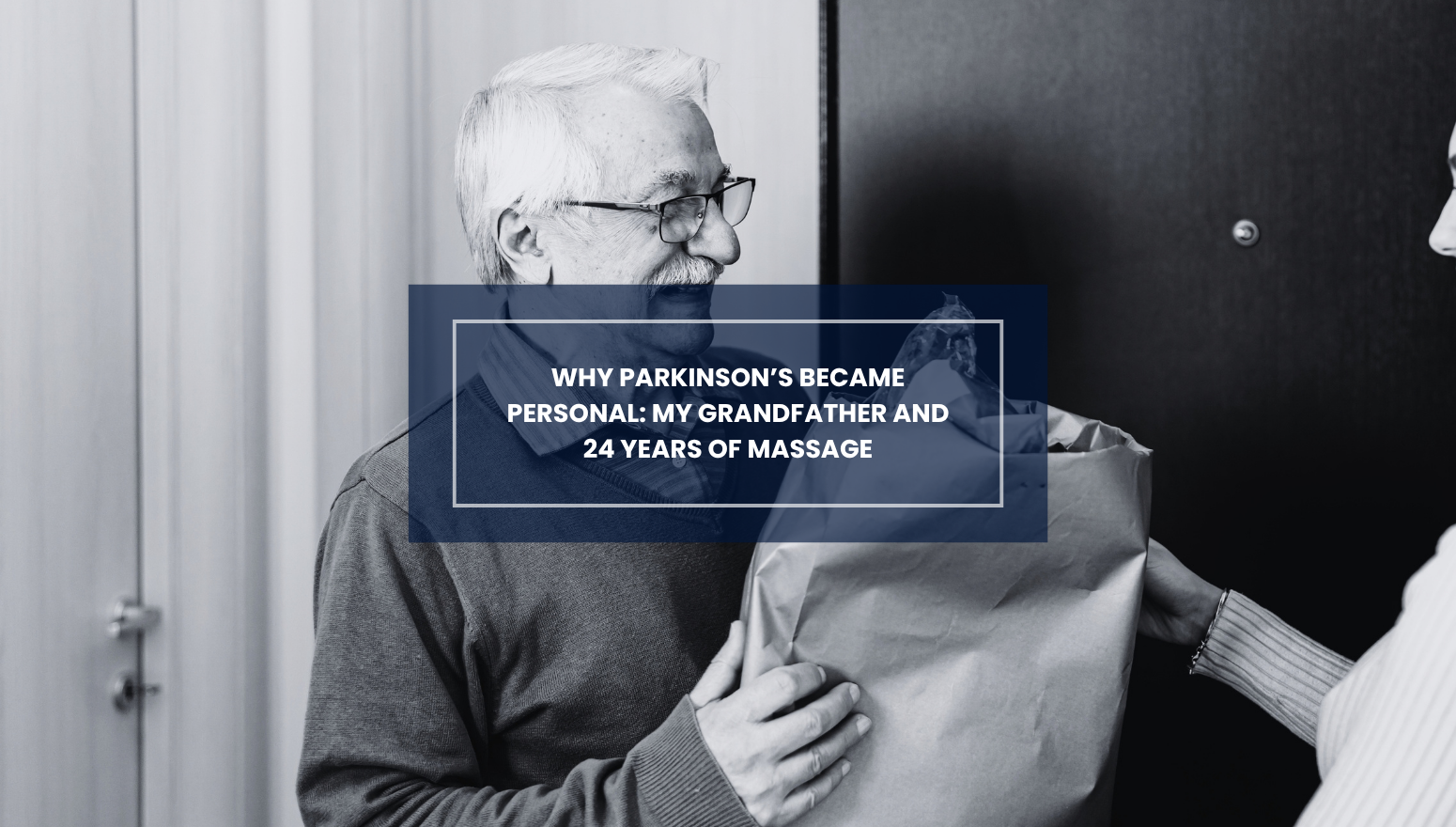
Parkinson’s became personal for me when my grandfather was diagnosed with the condition.
Losing him has made me think even more deeply about what it means to support someone living with a neurological condition. He was one of the most positive people I have ever known. He kept doing his exercises right up until the end, always finding a reason to keep going. His attitude stayed with me, and I think it always will.
My understanding of neurological conditions professionally comes from somewhere else too. I have spent many years working with people living with neurological injuries and conditions, and every client has taught me something about how differently these conditions can affect a person’s life.
Then, a couple of weeks after my grandfather died, I delivered a presentation for the Massage Association of Australia about neurodegenerative conditions and the practical considerations for massage therapists. Preparing that presentation was emotional, and it made me reflect on why parkinson’s became personal for me in a way I had not expected.
We are incredibly lucky to do what we do.
Parkinson’s became personal through my grandfather, but my years of working with neurological clients have given me another perspective on the condition too.
When you work in massage for a long time, it is easy for the work to become familiar. You assess someone, provide their treatment, have a conversation, finish the session and move on to the next client. Sometimes it can feel like it is simply a massage.
But when you step back and think about what that hour might mean to someone living with Parkinson’s, the picture becomes much bigger.
We are not treating Parkinson’s. We are not replacing medical care. We are working within our professional scope to provide appropriate care and support.
For one person, massage might be about discomfort or pain. For another, it might be about their experience of rigidity and tension. Someone else might value the opportunity to relax, take their mind off their condition for a while, or simply have some time where somebody else is taking care of them.
There is also something incredibly valuable about appropriate human touch.
Living with a neurological condition involves much more than symptoms. It can affect routines, independence, relationships, sleep, energy, confidence and everyday life. It can affect the people around the individual too, including partners, family members, friends and carers.
A massage session does not need to solve all of that to be meaningful. Sometimes its value is found in a much smaller moment, and I think that is something we can easily forget when we have been doing this work for years.
One of the things neurological education has taught me over the years, and something I have thought about even more since Parkinson’s became personal, is how important it is to understand the condition without assuming you know exactly how it affects the person in front of you.
Parkinson’s can present in many different ways. There can be movement difficulties, rigidity, tremor, fatigue, pain, sleep problems, changes in communication and changes in thinking or mood. Not everyone experiences the same symptoms, and symptoms can also change over time and from one day to another.
I have seen this with clients over the years. You might see someone one week and then see quite a different presentation the next time they come in.
That is why I do not believe a diagnosis tells you everything you need to know. It gives you important information, but it does not tell you what that person needs from you today.
As therapists, we still need to listen, observe, ask appropriate questions and understand what matters to the individual on the day. That is where our knowledge becomes useful.
A diagnosis is the starting point, not the whole picture
| What we know | What we still need to understand |
|---|---|
| The person has Parkinson’s | How Parkinson’s presents for them |
| They may experience movement changes | How they are moving today |
| Symptoms can fluctuate | What has changed since their last appointment |
| They may experience fatigue or pain | How much energy they have for the session |
| Their needs may change over time | What they want help with today |
| They have a neurological condition | What is appropriate within our professional scope |
This is why I am so passionate about neurological education.
It is not about turning massage therapists into something they are not. It is about giving them a better understanding of the person sitting in front of them.
After 24 years in massage, I have learned that there is no single approach that works for everyone. Two people can have the same diagnosis and have completely different experiences. Their symptoms, mobility, energy levels and priorities might all be different. Even what they want from a massage can be completely different.
I have worked with clients who wanted help with physical discomfort, while for someone else, the most important part of the session was having an hour to themselves, feeling cared for and having a break from everything else going on in their life.
For me, NeuroMassage has never been about having a different technique for every diagnosis. It is about understanding the condition, understanding the person and knowing how to work appropriately with the individual in front of you.
Why Parkinson’s Became Personal
Parkinson’s became personal for me through my grandfather. My clients have given me 24 years of professional experience working with neurological conditions, and those two things feel much more connected to me now.
Before my grandfather had Parkinson’s, I understood the condition professionally. After losing him, Parkinson’s became personal in a completely different way.
Parkinson’s became personal in a way I could never have understood simply from studying the condition professionally.
You notice the little things. You notice how much effort some everyday movements can take. You see the changes over time and the effect the condition has on the person, as well as the people around them.
You are also reminded that behind every diagnosis is a person. A person with their own personality, relationships, frustrations, routines, good days and difficult days.
My grandfather was so much more than his Parkinson’s, and I think that is something I will always carry with me when I work with someone living with the condition.
When I was preparing my presentation for the Massage Association of Australia, I found myself thinking about how easy it is, after many years in this profession, to forget just how important our work can be.
Massage is not a cure for Parkinson’s, and it does not replace medical care. But when it is provided by a therapist who understands the condition, understands the individual and works within their professional scope, it can still be a meaningful part of someone’s care and wellbeing.
Sometimes we get so caught up in techniques, assessments and treatment plans that we forget the simplest part of what we do. Sometimes we help someone feel more comfortable. Sometimes we give someone an hour where they feel looked after. Sometimes we provide a bit of connection and human touch.
How lucky are we to be able to do that?
That was one of the thoughts I kept coming back to after my presentation. It is also one of the reasons I care so much about neurological education.
I do not think massage therapists need to become something they are not. I think we need to understand more about the people we are already working with. When you understand more about a neurological condition, you have more information to guide your decisions. You are better placed to notice changes, ask the right questions and adapt your approach appropriately.
And after 24 years in this profession, I think that matters.
Parkinson’s became personal for me through my grandfather, but it has also become an important part of my professional understanding of NeuroMassage.
My grandfather gave me the personal connection. My clients have given me years of experience and learning. Together, they have reinforced something I have believed throughout my career.
There is real value in what massage therapists do.
We do not need to cure a condition to make a difference. We do not need to replace medical care. We need to understand the person, know our scope and provide the best care we can within it.
My grandfather reminded me of something I never want to lose sight of.
Sometimes, the work we do means much more to someone than we realise.
And after 24 years, I still feel incredibly lucky to be doing it.
Want to learn more about Parkinson’s and massage?
If you are a massage therapist working with people living with Parkinson’s, or you simply want to feel more confident supporting clients with neurological conditions, our NeuroMassage for Parkinson’s course explores the condition from a massage therapist’s perspective.
You’ll learn more about Parkinson’s, how it can present differently from person to person, and the practical considerations for working safely and appropriately within your professional scope.
Learn more about the NeuroMassage for Parkinson’s Course